
Steel sheet is a flat product made by rolling a steel slab and supplied as coil or cut sheets. This guide covers the types of steel sheet, the difference between hot and cold rolling, thickness ranges, the steel sheet weight chart and typical applications.
What is steel sheet?
A sheet is a product whose thickness is very small compared with its length and width. Its raw material is a slab, which is turned into steel strip on a hot rolling line. The strip is either used as it is (hot-rolled sheet) or processed further by pickling, cold rolling, galvanizing and painting to obtain a thinner gauge, a better surface or a protective coating.
Sheet is supplied in two forms: coil, a continuous wound strip, and cut sheets, cut to a fixed length. Common sheet sizes are 1000×2000, 1250×2500 and 1500×6000 mm.

Types of steel sheet
Thickness range by type
| Sheet type | Process | Typical thickness range | Key characteristic |
|---|---|---|---|
| Hot-rolled (black) sheet | Hot rolling | approx. 1.5 to 100 mm and above | High strength, dark rough surface |
| Pickled and oiled sheet | Hot rolling + pickling | approx. 1.5 to 6 mm | Scale-free surface |
| Cold-rolled sheet | Cold rolling | approx. 0.3 to 3 mm | Smooth surface, tight tolerances |
| Galvanized sheet | Hot-dip zinc coating | approx. 0.25 to 3 mm | Corrosion resistance |
| Pre-painted sheet | Continuous coil coating on coated sheet | approx. 0.2 to 1 mm | Decorative finish, double protection |
| Chequered plate | Hot rolling with patterned rolls | approx. 2 to 10 mm | Raised anti-slip pattern |
Ranges are approximate and indicate typical values; they depend on the capability of the production line.
Hot-rolled versus cold-rolled sheet
| Property | Hot-rolled sheet | Cold-rolled sheet |
|---|---|---|
| Rolling temperature | Above the recrystallization temperature | Room temperature |
| Surface quality | Dark, with mill scale | Smooth, bright and uniform |
| Dimensional accuracy | Wider tolerances | Tighter tolerances |
| Thickness range | Medium to heavy gauges | Light gauges |
| Typical use | Structures, tanks, heavy machinery | Car bodies, appliances, metal furniture |
Cold rolling work-hardens the steel: strength and hardness rise while formability falls. To restore formability, the sheet is annealed after cold rolling.
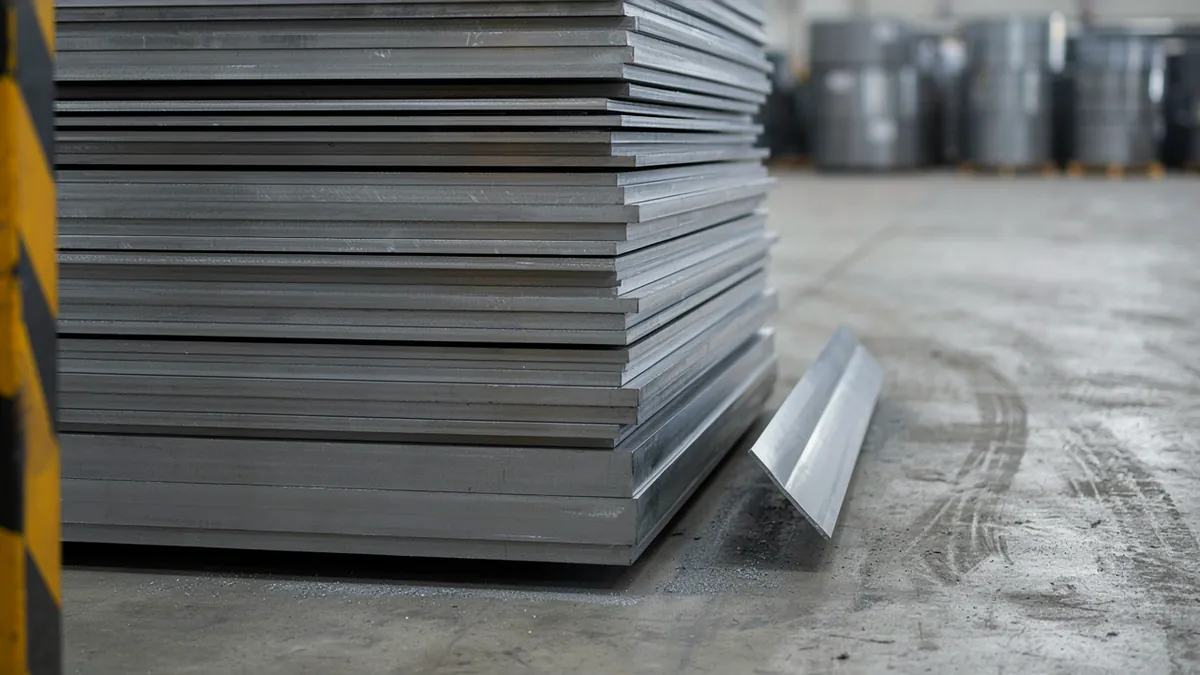
Steel sheet weight chart
| Thickness (mm) | Mass per m² (kg) | 1000×2000 sheet (kg) | 1250×2500 sheet (kg) | 1500×6000 sheet (kg) |
|---|---|---|---|---|
| 0.5 | 3.93 | 7.85 | 12.27 | 35.33 |
| 1 | 7.85 | 15.70 | 24.53 | 70.65 |
| 1.5 | 11.78 | 23.55 | 36.80 | 105.98 |
| 2 | 15.70 | 31.40 | 49.06 | 141.30 |
| 3 | 23.55 | 47.10 | 73.59 | 211.95 |
| 4 | 31.40 | 62.80 | 98.13 | 282.60 |
| 5 | 39.25 | 78.50 | 122.66 | 353.25 |
| 6 | 47.10 | 94.20 | 147.19 | 423.90 |
| 8 | 62.80 | 125.60 | 196.25 | 565.20 |
| 10 | 78.50 | 157.00 | 245.31 | 706.50 |
| 12 | 94.20 | 188.40 | 294.38 | 847.80 |
| 15 | 117.75 | 235.50 | 367.97 | 1059.75 |
| 20 | 157.00 | 314.00 | 490.63 | 1413.00 |
Theoretical masses based on a density of 7.85 g/cm³. For coated sheet, the mass of the coating is added to these values.
Theoretical mass based on a density of 7850 kg/m³; actual mass may differ slightly within the tolerance of the standard.
Sheet weight formula
With length and width in metres and thickness in millimetres, the mass in kilograms is:
W = L × B × t × 7.85
For example, a 1.25 × 2.5 m sheet 2 mm thick weighs about 49 kg.
Common steel grades for sheet
- Structural hot-rolled sheet: grades S235JR, S275JR and S355JR to EN 10025-2, also known by the older names St37, St44 and St52.
- Cold-rolled sheet: grades DC01, DC03 and DC04 to EN 10130, also known as St12, St13 and St14. The higher the number, the better the deep-drawing quality.
- Galvanized sheet: grades such as DX51D to EN 10346, together with a coating designation such as Z100 to Z275, which gives the total zinc mass on both sides in grams per square metre.
Applications of steel sheet
- Building and structures: plate girders, box columns, connection plates, steel decking and cladding.
- Tanks and pipes: storage tanks, pressure vessels and welded pipes.
- Automotive and transport: car bodies and chassis, rail wagons and shipbuilding.
- Appliances and metal furniture: refrigerator and washing machine bodies, cabinets and shelving.
- Building services: air ducts, cable trays and electrical enclosures.
Storage notes
- Store cold-rolled, galvanized and pre-painted sheet indoors in a dry place.
- Moisture trapped between layers of galvanized sheet causes white rust; good ventilation prevents it.
- Stack sheets on a flat surface with proper supports to prevent distortion.
- Avoid scratching coated sheet during handling, because damage to the coating is where corrosion starts.
Frequently asked questions about steel sheet
What is the difference between hot-rolled and cold-rolled sheet?
Hot-rolled sheet has a dark, rough surface. Cold-rolled sheet is made by further rolling it at room temperature and is thinner, smoother and more accurate in size.
How is the weight of a steel sheet calculated?
Multiply the length and width in metres by the thickness in millimetres and by 7.85. The result is the mass in kilograms.
Why does galvanized sheet resist rust?
The zinc coating acts as a barrier between the steel and its environment. Zinc is also more reactive than steel, so at small scratches it corrodes in place of the steel and protects it.
What does St37 mean?
St37 is the older name of a structural steel with a minimum tensile strength of about 360 to 370 MPa. In the current European standard it is called S235JR.
What is the difference between coil and sheet?
A coil is a continuous wound strip, while a sheet has been cut to a fixed length. The material and properties are the same.
Related steel sections
RebarI-beamProfilePipeAngle barChannel
References and standards
- EN 10025-2: Hot rolled products of non-alloy structural steels, technical delivery conditions
- EN 10051: Continuously hot-rolled strip and plate/sheet, tolerances on dimensions and shape
- EN 10130: Cold rolled low carbon steel flat products for cold forming
- EN 10346: Continuously hot-dip coated steel flat products
- ASTM A36/A36M: Standard specification for carbon structural steel
- ASTM A653/A653M: Standard specification for steel sheet, zinc-coated by the hot-dip process

