
A steel profile is a section whose cross-section is constant along its length. In everyday trade use the term mostly refers to square and rectangular hollow sections (box sections) and light sections formed from steel sheet. This guide covers profile types, the production process, the hollow section weight chart and applications.
What is a steel profile?
A profile is made by forming steel strip. The strip passes through successive rolls that bend it gradually into the required shape, and in closed sections the two edges are welded together. The result is a light, thin-walled section with a high strength-to-weight ratio.
Closed sections such as box sections are far stiffer in torsion than open sections of the same weight, and their flat faces make connecting, welding and fixing cladding simple.

Types of steel profile
How profiles are made
- Slitting: the coil is slit into strips whose width equals the perimeter of the section.
- Roll forming: the strip is bent step by step as it passes through the roll stands.
- Seam welding: the strip edges are heated by high-frequency current and pressed together (ERW). The outer weld bead is removed.
- Sizing and final shaping: the section is brought to exact dimensions. In one method a round tube is made first and then shaped into a square or rectangle; in the direct method the strip is bent straight into a box shape.
- Cutting: the product is cut to standard length, usually 6 m.
Designation and dimensions of hollow sections
A hollow section is described by its outside dimensions and wall thickness; for example, 40×40×2 is a square section with 40 mm sides and a 2 mm wall. In international standards, square sections are abbreviated SHS and rectangular sections RHS.

Hollow section weight chart
| Section size (mm) | Wall thickness (mm) | Approx. mass per metre (kg) | Approx. mass of a 6 m length (kg) |
|---|---|---|---|
| 20 × 20 | 2 | 1.13 | 6.8 |
| 30 × 30 | 2 | 1.76 | 10.5 |
| 40 × 40 | 2 | 2.39 | 14.3 |
| 40 × 40 | 2.5 | 2.94 | 17.7 |
| 50 × 50 | 2.5 | 3.73 | 22.4 |
| 60 × 60 | 3 | 5.37 | 32.2 |
| 80 × 80 | 3 | 7.25 | 43.5 |
| 100 × 100 | 4 | 12.06 | 72.3 |
| 40 × 20 | 2 | 1.76 | 10.5 |
| 60 × 40 | 2.5 | 3.73 | 22.4 |
| 80 × 40 | 3 | 5.37 | 32.2 |
| 100 × 50 | 3 | 6.78 | 40.7 |
Masses are theoretical and approximate, calculated without allowing for the rounded corners; actual mass is slightly lower.
Theoretical mass based on a density of 7850 kg/m³; actual mass may differ slightly within the tolerance of the standard.
Hollow section weight formula
With the outside dimensions (a and b) and thickness (t) in millimetres, the approximate mass per metre in kilograms is:
W = [2(a + b) − 4t] × t × 0.00785
For example, a 60×40 section with a 2.5 mm wall weighs (200 minus 10) × 2.5 × 0.00785, or about 3.73 kg per metre.
Steel grades for profiles
Cold-formed structural hollow sections to EN 10219 are produced in grades such as S235JRH, S275J0H and S355J2H, where the number is the minimum yield strength in megapascals. Hot-finished hollow sections are covered by EN 10210.
Technical note: cold forming work-hardens the steel at the corners of the section. Design codes therefore set specific rules for welding in the corner zones of cold-formed sections.
Applications of profiles
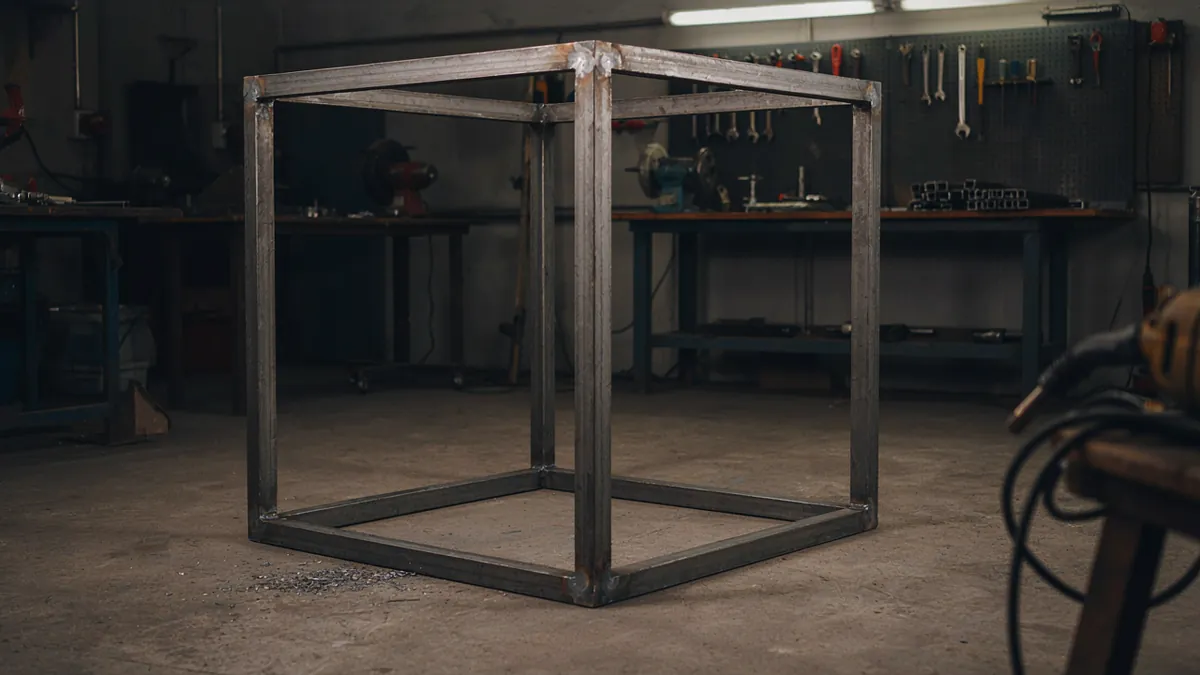
- Buildings: wall posts, light trusses, façade support structures, railings, guards and stairs.
- Industrial buildings: Z and C purlins, bracing and support structures.
- Doors and windows: steel door frames and leaves.
- Machinery and vehicles: equipment frames, bus and trailer bodies.
- Furniture and interiors: tables, chairs, shelving and exhibition structures.
- Greenhouses and agricultural structures: light galvanized frames and posts.
Storage notes
- Store profiles under cover and on supports so that water does not collect inside hollow sections.
- Thin furniture profiles are sensitive to impact and bending and need adequate support when stacked.
- Remove oil and dirt from the surface before painting.
Frequently asked questions about steel profiles
What is the difference between a profile and a box section?
Profile is a general name for sections with a constant cross-section, and a box section is one type of profile with a square or rectangular hollow shape. In trade use the two words are often interchangeable.
What is the difference between structural and industrial profiles?
The main difference is wall thickness and use. Industrial profiles are thicker and are used for load-bearing members and frames, while structural profiles are lighter.
How is the weight of a hollow section calculated?
Subtract four times the thickness from the perimeter, multiply by the thickness and then by 0.00785 to get the approximate mass per metre in kilograms.
What is the standard length of a profile?
The common length is 6 m, although other lengths can be produced.
What is the advantage of a galvanized profile?
The zinc coating protects the steel against corrosion and extends its life outdoors and in humid environments.
Related steel sections
RebarI-beamSheetPipeAngle barChannel
References and standards
- EN 10219-1 and EN 10219-2: Cold formed welded structural hollow sections, technical delivery conditions, tolerances and dimensions
- EN 10210: Hot finished structural hollow sections
- ASTM A500/A500M: Cold-formed welded and seamless carbon steel structural tubing
- EN 10162: Cold rolled steel sections, dimensional and cross-sectional tolerances
- Iranian National Building Regulations, Part 10: Design and construction of steel buildings

