
A steel pipe is a hollow section with a circular cross-section, used to carry fluids such as water, gas, oil and steam, and also as a structural member. This guide covers the types of steel pipe, manufacturing methods, nominal size and schedule, the pipe dimension and weight chart, and the reference standards.
What is steel pipe?
A circular cross-section distributes the internal pressure of a fluid evenly around the wall, which makes a pipe the most suitable shape for carrying fluids under pressure. Thanks to their high strength, resistance to temperature and pressure, and weldability, steel pipes are the backbone of water, gas and oil networks and of industrial plants.
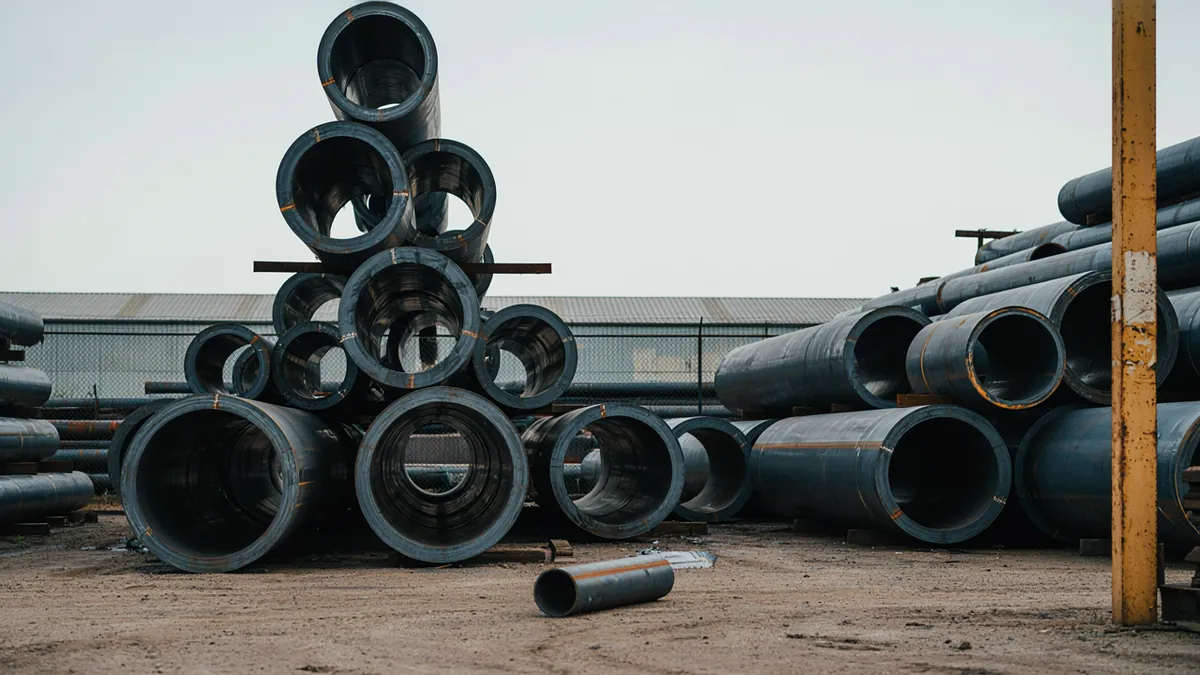
Types of steel pipe by manufacturing method
| Pipe type | Manufacturing method | Typical diameter range | Typical use |
|---|---|---|---|
| Seamless | Piercing a hot billet, then rolling | Small to medium | High pressure and temperature, boilers, hydraulics |
| ERW (longitudinal weld) | Forming steel strip, high-frequency resistance weld | Small to medium | Water, gas, structures, scaffolding |
| LSAW (longitudinal weld) | Forming heavy plate, submerged-arc longitudinal weld | Medium to large | Oil and gas transmission, offshore structures |
| Spiral (SSAW) | Helical forming of strip, submerged-arc weld | Large | Water transmission, piling, low-pressure lines |
Seamless pipe
A round steel billet is heated to a high temperature and passed between inclined rolls over a piercing plug, which opens a hole along its centre. Rolling then brings the diameter and wall to their final size. Because the wall has no weld line, its resistance to pressure is uniform all around.
Welded pipe
Welded pipe is made by forming steel plate or strip and welding its edges. Depending on the direction of the seam, it is either longitudinally welded (the seam runs along the pipe) or spiral welded (a helical seam). This route allows large diameters and a uniform wall thickness.
Types of pipe by application
Nominal size and schedule explained
Pipe size is given as a nominal size, called NPS in the inch system and DN in the metric system. The nominal size is a designation and does not equal the actual diameter; a 2 inch pipe, for example, has an outside diameter of 60.3 mm.
For each nominal size the outside diameter is fixed, and the schedule defines the wall thickness. As the schedule number rises, the wall becomes thicker, the inside diameter smaller, and the pipe can withstand higher pressure.

Steel pipe dimension and weight chart (Schedule 40)
| Nominal size NPS (in) | DN | Outside diameter (mm) | Schedule 40 wall (mm) | Mass per metre (kg) |
|---|---|---|---|---|
| 1/2 | 15 | 21.3 | 2.77 | 1.27 |
| 3/4 | 20 | 26.7 | 2.87 | 1.69 |
| 1 | 25 | 33.4 | 3.38 | 2.50 |
| 1 1/4 | 32 | 42.2 | 3.56 | 3.39 |
| 1 1/2 | 40 | 48.3 | 3.68 | 4.05 |
| 2 | 50 | 60.3 | 3.91 | 5.44 |
| 2 1/2 | 65 | 73.0 | 5.16 | 8.63 |
| 3 | 80 | 88.9 | 5.49 | 11.29 |
| 4 | 100 | 114.3 | 6.02 | 16.07 |
| 5 | 125 | 141.3 | 6.55 | 21.77 |
| 6 | 150 | 168.3 | 7.11 | 28.26 |
| 8 | 200 | 219.1 | 8.18 | 42.55 |
| 10 | 250 | 273.0 | 9.27 | 60.29 |
| 12 | 300 | 323.8 | 10.31 | 79.70 |
Dimensions to ASME B36.10M; masses are theoretical values for plain-end black pipe.
Theoretical mass based on a density of 7850 kg/m³; actual mass may differ slightly within the tolerance of the standard.
Pipe weight formula
With the outside diameter (OD) and wall thickness (t) in millimetres, the mass per metre in kilograms is:
W = (OD − t) × t × 0.02466
For example, a 4 inch Schedule 40 pipe weighs (114.3 minus 6.02) × 6.02 × 0.02466, or about 16.07 kg per metre.
Applications of steel pipe

- Oil, gas and petrochemicals: transmission lines, process piping and refinery installations.
- Water and wastewater: transmission mains, distribution networks and pumping stations.
- Building services: gas supply, fire protection, heating and cooling.
- Power plants and industry: steam lines, boilers and heat exchangers.
- Structures: columns, space frames, steel piles, scaffolding and railings.
Storage notes
- Stack pipes on timber supports with side restraints to prevent rolling and contact with the ground.
- Protect pipe ends and threads with caps to avoid damage and keep dirt out.
- Store galvanized pipe in a dry, ventilated place to prevent white rust.
Frequently asked questions about steel pipe
What is the difference between welded and seamless pipe?
Welded pipe is made by bending and welding steel sheet and has a weld seam. Seamless pipe is made by piercing a hot billet, has no seam and is better suited to high pressure and temperature.
What does Schedule 40 mean?
The schedule is a number that defines the wall thickness of a pipe for each nominal size. The higher the schedule, the thicker the wall.
Is the nominal size the same as the outside diameter?
No. The nominal size is only a designation. A 1 inch pipe, for example, has an outside diameter of 33.4 mm.
How is the weight of a steel pipe calculated?
Subtract the wall thickness from the outside diameter, multiply the result by the thickness and then by 0.02466 to get the mass per metre in kilograms.
What is the difference between ERW and spiral pipe?
ERW pipe has a straight seam along its length and is common in small to medium diameters. Spiral pipe has a helical seam and is used for large diameters.
Related steel sections
RebarI-beamSheetProfileAngle barChannel
References and standards
- ASME B36.10M: Welded and seamless wrought steel pipe
- API 5L: Specification for line pipe
- ASTM A53/A53M: Pipe, steel, black and hot-dipped, zinc-coated, welded and seamless
- ASTM A106/A106M: Seamless carbon steel pipe for high-temperature service
- EN 10255: Non-alloy steel tubes suitable for welding and threading
- EN 39: Loose steel tubes for tube and coupler scaffolds

