
An I-beam is a hot-rolled steel section with an I- or H-shaped cross-section, used as a bending member and as a column in steel structures. This guide covers I-beam types, the parts of the section, IPE and HEB size and weight charts, steel grades and applications.
What is an I-beam and what are its parts?
An I-beam has two main parts: the flanges, the horizontal plates at the top and bottom, and the web, the vertical plate that joins them. When a beam bends under load, the highest stress occurs at the points farthest from the centre of the section. In an I-beam most of the steel is placed in the flanges, exactly at those far points, so high bending resistance is achieved with less steel. The web carries the shear force.
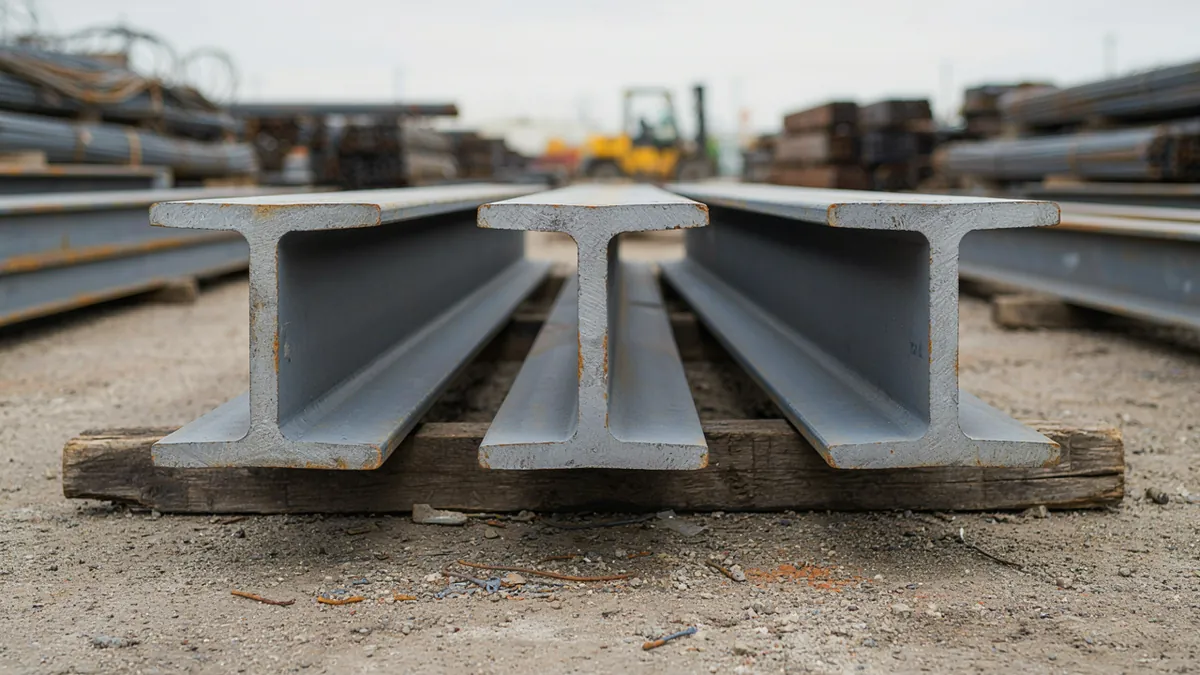
Types of I-beam
Designation and section dimensions
The size number of a beam is the nominal depth of the section in millimetres. For example, IPE 140 has a depth of 140 mm.

IPE beam size and weight chart
| Size | Depth h (mm) | Flange width b (mm) | Web tw (mm) | Flange tf (mm) | Mass per metre (kg) | Mass of a 12 m length (kg) |
|---|---|---|---|---|---|---|
| IPE 80 | 80 | 46 | 3.8 | 5.2 | 6.0 | 72 |
| IPE 100 | 100 | 55 | 4.1 | 5.7 | 8.1 | 97 |
| IPE 120 | 120 | 64 | 4.4 | 6.3 | 10.4 | 125 |
| IPE 140 | 140 | 73 | 4.7 | 6.9 | 12.9 | 155 |
| IPE 160 | 160 | 82 | 5.0 | 7.4 | 15.8 | 190 |
| IPE 180 | 180 | 91 | 5.3 | 8.0 | 18.8 | 226 |
| IPE 200 | 200 | 100 | 5.6 | 8.5 | 22.4 | 269 |
| IPE 220 | 220 | 110 | 5.9 | 9.2 | 26.2 | 314 |
| IPE 240 | 240 | 120 | 6.2 | 9.8 | 30.7 | 368 |
| IPE 270 | 270 | 135 | 6.6 | 10.2 | 36.1 | 433 |
| IPE 300 | 300 | 150 | 7.1 | 10.7 | 42.2 | 506 |
| IPE 330 | 330 | 160 | 7.5 | 11.5 | 49.1 | 589 |
| IPE 360 | 360 | 170 | 8.0 | 12.7 | 57.1 | 685 |
| IPE 400 | 400 | 180 | 8.6 | 13.5 | 66.3 | 796 |
| IPE 450 | 450 | 190 | 9.4 | 14.6 | 77.6 | 931 |
| IPE 500 | 500 | 200 | 10.2 | 16.0 | 90.7 | 1088 |
| IPE 550 | 550 | 210 | 11.1 | 17.2 | 106 | 1272 |
| IPE 600 | 600 | 220 | 12.0 | 19.0 | 122 | 1464 |
Nominal dimensions and masses according to EN 10365. Actual mass may vary within the tolerance permitted by the standard.
Wide-flange (HEB) beam size and weight chart
| Size | Depth h (mm) | Flange width b (mm) | Web tw (mm) | Flange tf (mm) | Mass per metre (kg) |
|---|---|---|---|---|---|
| HEB 100 | 100 | 100 | 6.0 | 10.0 | 20.4 |
| HEB 120 | 120 | 120 | 6.5 | 11.0 | 26.7 |
| HEB 140 | 140 | 140 | 7.0 | 12.0 | 33.7 |
| HEB 160 | 160 | 160 | 8.0 | 13.0 | 42.6 |
| HEB 180 | 180 | 180 | 8.5 | 14.0 | 51.2 |
| HEB 200 | 200 | 200 | 9.0 | 15.0 | 61.3 |
| HEB 240 | 240 | 240 | 10.0 | 17.0 | 83.2 |
| HEB 300 | 300 | 300 | 11.0 | 19.0 | 117 |
Theoretical mass based on a density of 7850 kg/m³; actual mass may differ slightly within the tolerance of the standard.
Comparing the two tables shows that an HEB beam of the same depth has wider, thicker flanges and is therefore much heavier. For instance, IPE 200 weighs about 22.4 kg per metre and HEB 200 about 61.3 kg per metre.
Steel grades for beams
Beams are normally made from non-alloy structural steels. The common grades according to EN 10025-2 are:
| Grade (EN 10025-2) | Former DIN name | Min. yield strength (MPa) | Tensile strength (MPa) |
|---|---|---|---|
| S235JR | St37-2 | 235 | 360 – 510 |
| S275JR | St44-2 | 275 | 410 – 560 |
| S355JR | St52-3 | 355 | 470 – 630 |
Values apply to nominal thicknesses up to 16 mm. Minimum yield strength decreases slightly as thickness increases.
How I-beams are made
I-beams are produced by hot rolling. A steel bloom or beam blank is reheated to rolling temperature and passed repeatedly through rolling stands, gradually taking the I shape. After rolling, the product cools on a cooling bed, is straightened and is cut to standard length.
Applications of I-beams
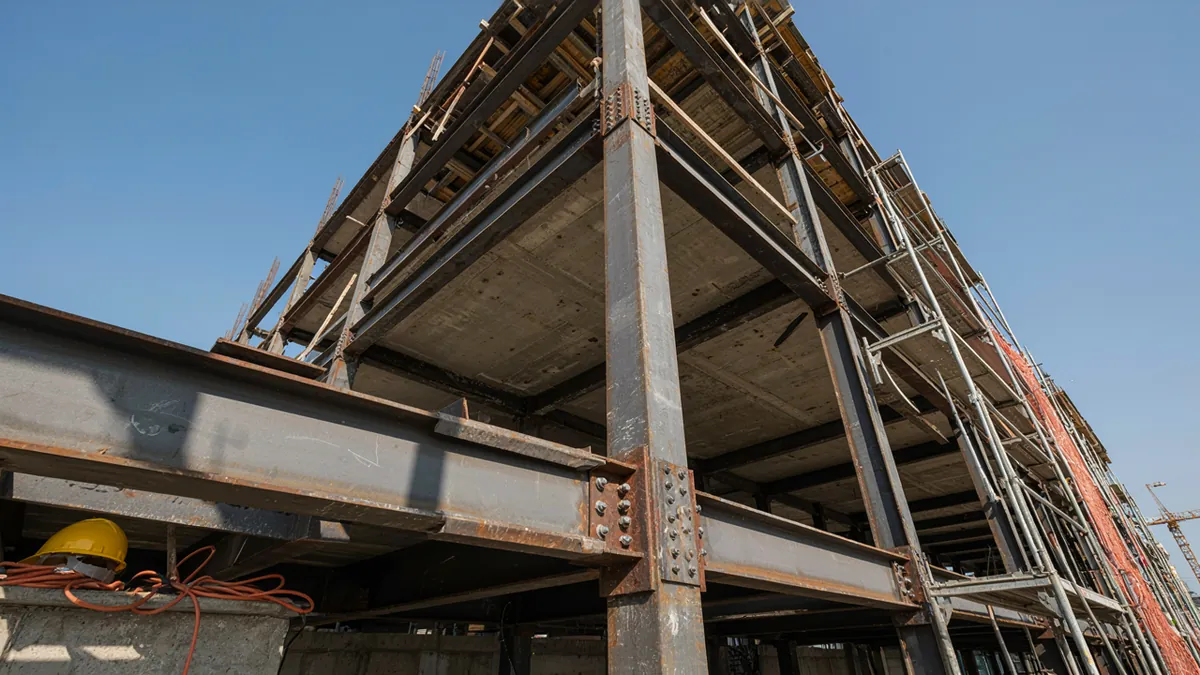
- Steel building frames: main and secondary beams, columns and bracing.
- Floors: steel joists and beams of composite floors.
- Industrial buildings: portal frames, crane runway beams and platforms.
- Bridges: main girders and deck members.
- Machinery: frames for heavy equipment, trailers and support structures.
IPE or H-beam? An IPE beam has more depth for its weight, which makes it economical for bending members such as beams. A wide-flange beam is stiff in both directions, which makes it better suited to columns and compression members.
Storage notes
- Stack lengths on level supports, clear of the ground, to prevent bending and contact with moisture.
- For long outdoor storage, covering or a protective primer prevents rusting.
- Before use, check straightness, section dimensions and the absence of cracks or twist.
Frequently asked questions about I-beams
What is the difference between an I-beam and an H-beam?
In a standard I-beam (IPE) the depth is about twice the flange width, while in an H-beam or wide-flange beam the flange width is close to the depth. H-beams are heavier and are mostly used as columns.
What does the size number of a beam mean?
It is the nominal depth of the section. For example, IPE 180 has a depth of 180 mm.
How is the weight of a beam calculated?
Read the mass per metre from the standard table and multiply by the length. For example, IPE 160 at 15.8 kg per metre weighs about 190 kg for a 12 m length.
What is the advantage of a castellated beam?
Cutting and re-welding the web makes the beam about one and a half times deeper, increasing bending strength and stiffness with no added weight. The web openings can also be used to pass building services.
What is the standard length of an I-beam?
The common length is 12 m.
Related steel sections
RebarSheetProfilePipeAngle barChannel
References and standards
- EN 10365: Hot rolled steel channels, I and H sections, dimensions and masses
- DIN 1025-5 and DIN 1025-2: Dimensions of IPE and IPB beams
- EN 10034: Structural steel I and H sections, tolerances on shape and dimensions
- EN 10025-2: Hot rolled products of non-alloy structural steels, technical delivery conditions
- INSO 1791 (Iranian National Standard): Hot-rolled I-beams
- Iranian National Building Regulations, Part 10: Design and construction of steel buildings

