
An angle bar is a steel section with an L-shaped cross-section, formed by two legs at right angles. This simple section is one of the most widely used members in connections, trusses, towers and steel frames. This guide covers angle types, hot-rolled versus press-formed angles, the angle bar weight chart and applications.
What is an angle bar?
An angle consists of two steel plates called legs, joined at 90 degrees. This shape provides a convenient surface for bolting or welding two perpendicular members, and it also performs well under axial tension and compression. Angles can be used singly, or in pairs and groups to make built-up sections.

Types of angle bar
Hot-rolled versus press-formed angle
| Property | Hot-rolled angle | Press-formed angle (bent from sheet) |
|---|---|---|
| Process | Hot rolling of a steel billet | Slitting sheet and cold bending |
| Outer corner | Sharp, square | Rounded |
| Inner corner | Root radius (fillet) that stiffens the section | Rounded, no fillet |
| Available thickness | Light to heavy | Usually light to medium |
| Typical use | Structural, load-bearing members | Light fabrication, frames and trims |
Designation and dimensions
An angle is described by its leg lengths and thickness. For example, L 50×50×5 is an equal-leg angle with 50 mm legs and a thickness of 5 mm.

Equal-leg angle weight chart
| Size (mm) | Thickness (mm) | Cross-section (cm²) | Mass per metre (kg) | Mass of a 6 m length (kg) |
|---|---|---|---|---|
| 25 × 25 | 3 | 1.42 | 1.12 | 6.7 |
| 30 × 30 | 3 | 1.74 | 1.36 | 8.2 |
| 40 × 40 | 4 | 3.08 | 2.42 | 14.5 |
| 50 × 50 | 5 | 4.80 | 3.77 | 22.6 |
| 60 × 60 | 6 | 6.91 | 5.42 | 32.5 |
| 70 × 70 | 7 | 9.40 | 7.38 | 44.3 |
| 80 × 80 | 8 | 12.3 | 9.63 | 57.8 |
| 90 × 90 | 9 | 15.5 | 12.2 | 73.2 |
| 100 × 100 | 10 | 19.2 | 15.0 | 90.0 |
| 120 × 120 | 12 | 27.5 | 21.6 | 129.6 |
| 150 × 150 | 15 | 43.0 | 33.8 | 202.8 |
| 200 × 200 | 20 | 76.3 | 59.9 | 359.4 |
Nominal dimensions and masses for hot-rolled angles according to EN 10056-1. Actual mass may vary within the tolerance permitted by the standard.
Theoretical mass based on a density of 7850 kg/m³; actual mass may differ slightly within the tolerance of the standard.
Angle weight formula
With the leg length (a) and thickness (t) in millimetres, the approximate mass per metre of an equal-leg angle in kilograms is:
W = (2a − t) × t × 0.00785
For example, a 50×50×5 angle weighs (100 minus 5) × 5 × 0.00785, or about 3.73 kg per metre. The table value (3.77) is slightly higher because it also includes the root radius at the inner corner.
Steel grades for angles
Structural angles are normally made from non-alloy structural steels:
| Grade (EN 10025-2) | Former DIN name | Min. yield strength (MPa) | Tensile strength (MPa) |
|---|---|---|---|
| S235JR | St37-2 | 235 | 360 – 510 |
| S275JR | St44-2 | 275 | 410 – 560 |
| S355JR | St52-3 | 355 | 470 – 630 |
Values apply to nominal thicknesses up to 16 mm, according to EN 10025-2.
Applications of angle bars
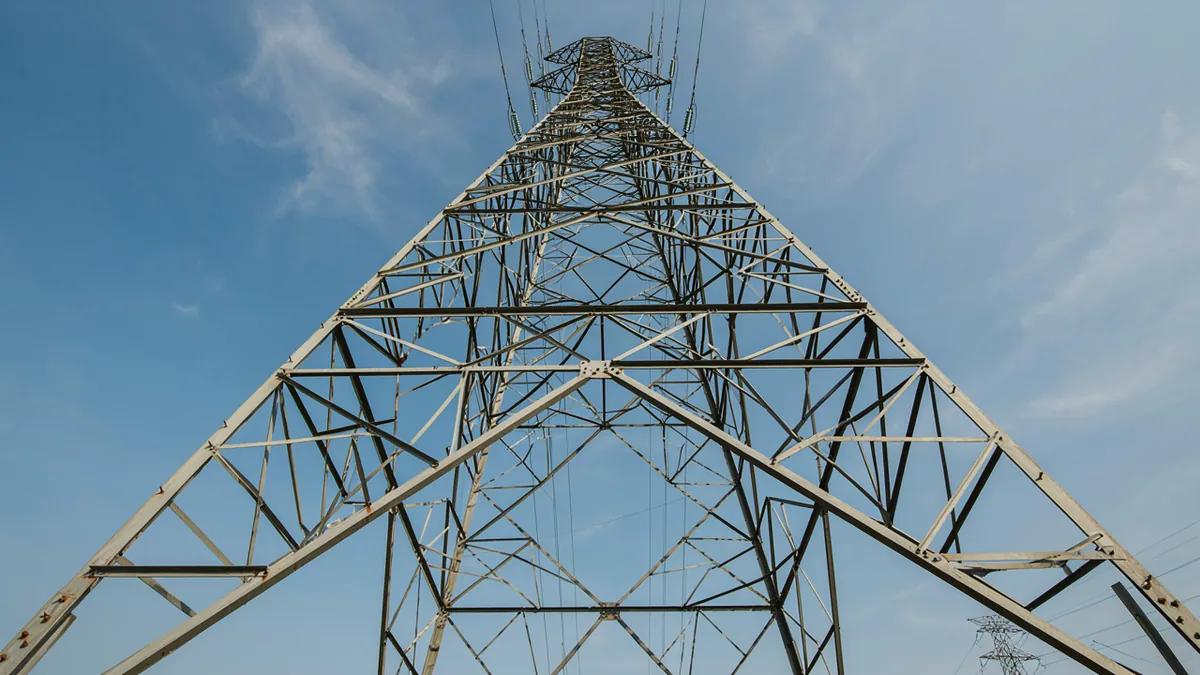
- Structural connections: seat angles and web cleats in beam-to-column connections.
- Trusses and bracing: members of roof trusses and bracing in buildings and industrial halls.
- Towers: lattice towers for power transmission and telecommunications.
- Built-up sections: latticed columns and beams made by combining several angles.
- Frames: frames for doors, windows, hatches and guards.
- Industry: equipment frames, industrial racking, tank supports and conveyors.
Design note: in a single angle the line of force usually does not pass through the centroid of the section, which creates eccentricity. Design codes therefore include specific rules for single-angle members.
Storage notes
- Stack lengths on supports, clear of the ground, to prevent bending and rusting.
- Keep different sizes and thicknesses apart.
- Before use, check that the legs are square and the length is straight.
Frequently asked questions about angle bars
What is the difference between hot-rolled and press-formed angles?
A hot-rolled angle has a sharp outer corner and a reinforced inner corner and suits load-bearing members. A press-formed angle is bent from sheet, has a rounded corner and is used for lighter work.
How is an angle bar designated?
By its two leg lengths and its thickness in millimetres, for example L 50×50×5.
How is the weight of an angle calculated?
Subtract the thickness from twice the leg length, multiply by the thickness and then by 0.00785 to get the approximate mass per metre in kilograms.
Where are unequal-leg angles used?
Where more connection surface or stiffness is needed in one direction, as in some connections and truss members.
What is the standard length of an angle bar?
Angles are usually produced in 6 m and 12 m lengths.
Related steel sections
RebarI-beamSheetProfilePipeChannel
References and standards
- EN 10056-1: Structural steel equal and unequal leg angles, dimensions
- EN 10056-2: Structural steel equal and unequal leg angles, tolerances on shape and dimensions
- EN 10025-2: Hot rolled products of non-alloy structural steels, technical delivery conditions
- ASTM A36/A36M: Standard specification for carbon structural steel
- Iranian National Building Regulations, Part 10: Design and construction of steel buildings

